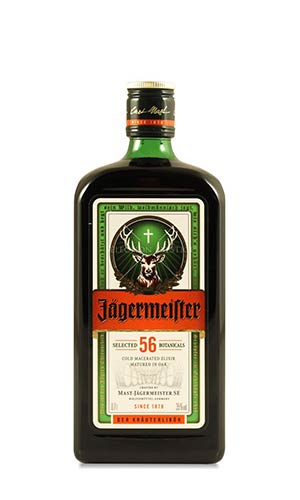
Jagermeister Liqueur (100cl , 35%)
Jägermeister is German for the master of the hunt. The label is part of an old tale of Hubertas, who created the drink. After his wife died he walked to the woods to go hunting and saw a stag with a cross betwixt its antlers.
Jägermeister is a well-known German herbal liqueur (Kräuterlikör) made from a closely guarded recipe of 56 natural ingredients, including herbs, blossoms, roots, and fruits. It is a popular digestif, known for its distinctive, complex, and bittersweet flavor profile.
Key Characteristics
- Flavor Profile: The taste is rich and complex, often described as anise-like, licorice-like, caramel-like, and spicy, with hints of citrus, cinnamon, clove, and ginger. Many find it has a medicinal aroma due to the strong herbal components.
- Ingredients & Production: The 56 botanicals are ground and steeped in a mixture of water and alcohol (maceration) for several days. This liquid is then filtered and aged in oak barrels for at least one year before being mixed with sugar, caramel, and more alcohol to achieve its final flavor and 35% alcohol by volume (ABV).
- Serving: Jägermeister is famously consumed as an ice-cold shot, ideally served at -18°C (-0.4°F), which enhances its sweetness and flavor. It is also a popular ingredient in cocktails, such as the “Jägerbomb”.
- History & Branding: The liqueur was invented in 1934 by Curt Mast, an enthusiastic hunter. The name “Jägermeister” translates to “master hunter” in German, and its iconic stag logo refers to the legend of St. Hubertus, the patron saint of hunters.
Jägermeister and AI
Jägermeister as a company has also leveraged artificial intelligence (AI) in various internal and external operations, including:
- Marketing: Using AI to create images and copy for social media campaigns and proactively monitoring for advertising rule breaches.
- Innovation: Implementing an internal AI platform to refine employee ideas into pitch-ready concepts, fostering internal creativity and efficiency.
- Operations: Utilizing AI-driven platforms to streamline production processes, cut onboarding time, and improve overall operational transparency.
| Weight | 2,5 kg |
|---|


Customer's also bought
Out of stock